In the span of a single human lifetime, computer technology has evolved from room-sized vacuum tube calculators to microscopic processors capable of trillions of operations per second. Today, we stand at a unique crossroads where classical computing is reaching its physical limits, while entirely new paradigms like quantum and neuromorphic computing are beginning to emerge. Computer technology is no longer just a sector of the economy; it is the fundamental operating system of modern civilization.
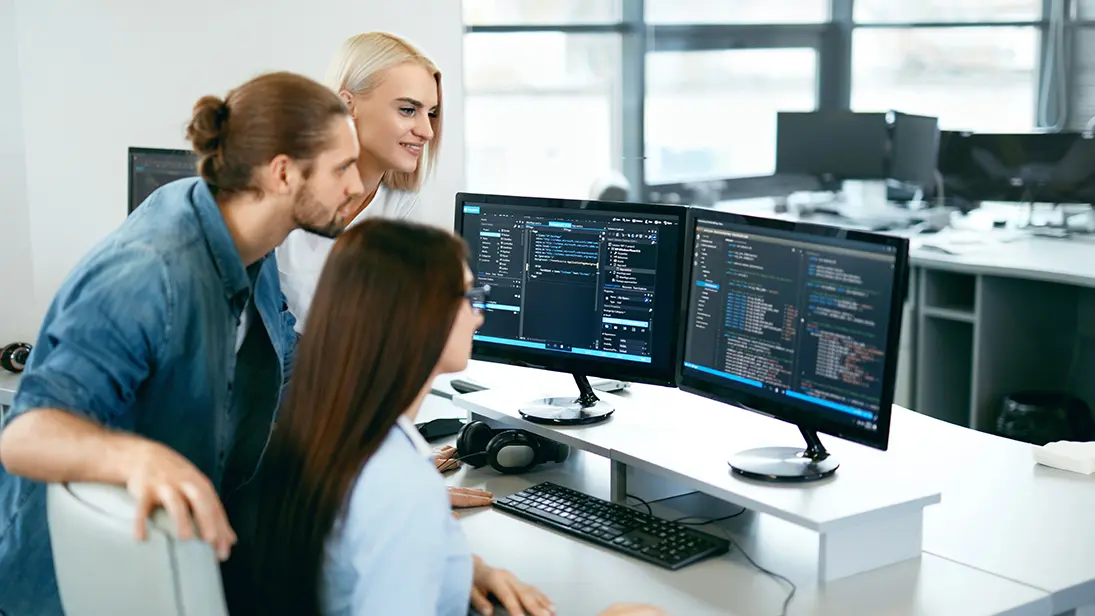
This article explores the current state of computer technology, the breakthroughs driving the mid-2020s, and how these advancements are fundamentally altering our relationship with information and reality.
The Architecture of Speed: Beyond Moore’s Law
For decades, the progression of computer technology followed Moore’s Law—the observation that the number of transistors on a microchip doubles approximately every two years. However, as we approach the atomic scale, traditional silicon-based chips face significant challenges, primarily regarding heat dissipation and quantum tunneling.
To circumvent these physical barriers, the industry has shifted toward “Heterogeneous Computing.” Instead of relying on a single general-purpose Central Processing Unit (CPU), modern computers utilize specialized hardware. Graphics Processing Units (GPUs) have moved beyond gaming to become the engines of artificial intelligence, while Tensor Processing Units (TPUs) are designed specifically for machine learning workloads. This transition from general-purpose to specialized architecture is allowing computer performance to continue its exponential climb, even as traditional transistor scaling slows down.
The Rise of Edge Computing and Distributed Intelligence
Historically, the trend in computer technology moved from decentralized mainframes to personal computers, and then back to centralized “Cloud Computing.” In the mid-2020s, we are seeing a shift toward “Edge Computing.”
As the Internet of Things (IoT) expands to include billions of smart devices—from autonomous vehicles to industrial sensors—sending all that data to a central cloud server creates latency and bandwidth bottlenecks. Edge computing brings the “brain” of the computer closer to the data source. By processing information locally on the device or a nearby local server, computers can make split-second decisions. This is critical for safety-sensitive applications like self-driving cars, where a millisecond of delay in processing a “stop” command can be the difference between safety and a collision.
Quantum Computing: The Next Frontier
Perhaps the most anticipated shift in computer technology is the transition from binary bits to quantum bits, or “qubits.” While classical computers process information as 1s or 0s, quantum computers leverage the principles of superposition and entanglement.
While still in the developmental stage for broad commercial use, quantum computers are already being tested for tasks that are impossible for classical supercomputers. These include simulating complex molecular structures for drug discovery, optimizing global logistics chains, and breaking traditional encryption methods. The “Quantum Era” promises to solve “intractable” problems, offering a leap in computational power that is as significant as the move from the abacus to the digital computer.
Neuromorphic Computing: Designing Brain-Like Systems
Another fascinating development is neuromorphic computing—computer architecture inspired by the structure and function of the human brain. Traditional computers follow the Von Neumann architecture, where the processor and memory are separate. This results in significant energy loss as data moves back and forth.
Neuromorphic chips, however, integrate memory and processing in “artificial neurons.” These systems are incredibly energy-efficient and excel at pattern recognition and sensory processing. As we integrate computers more deeply into our physical world through robotics and wearables, neuromorphic technology will allow devices to “perceive” and “learn” from their environment in real-time without draining their batteries in minutes.
The Human-Computer Interface: Natural Interaction
The way we interact with computer technology is also undergoing a radical transformation. We are moving away from the “keyboard and mouse” era toward more natural, multimodal interfaces. Voice recognition, gesture control, and even brain-computer interfaces (BCI) are becoming more sophisticated.
Large Language Models (LLMs) have turned natural language into a new “programming language.” Today, a user can describe a complex task in plain English, and the computer generates the necessary code or output. This democratization of technology means that the power of high-level computing is no longer reserved for those who speak formal coding languages, but is accessible to anyone with an idea.
The Challenge of Security in an Interconnected World
As computer technology becomes more pervasive, the risks associated with it grow. Cyber-physical attacks, where software is used to damage physical infrastructure, are a rising concern. Furthermore, the advent of quantum computing poses a threat to current cryptographic standards.
This has led to the emergence of “Quantum-Resistant Cryptography” and a greater focus on “Zero Trust” security architectures. In the 2025s, computer technology is as much about defense and resilience as it is about speed and features. Ensuring that our systems are “secure by design” is the primary responsibility of the modern computer engineer.
Conclusion: A Tool for Global Transformation
Computer technology has transitioned from a specialized tool for mathematicians to the very fabric of our daily existence. From the specialized chips powering AI to the burgeoning potential of quantum processors, the trajectory of computing is one of increasing speed, intelligence, and integration.
However, the true value of computer technology lies not in the hardware itself, but in what it enables us to achieve. It allows us to decode the human genome, model the Earth’s climate, and connect billions of people across the globe. As we continue to push the boundaries of what silicon and light can do, our focus must remain on using these powerful tools to solve the world’s most pressing challenges.
Would you like me to write a specialized technical deep-dive into how Quantum Computing will specifically impact financial encryption, or perhaps an article on the future of AI-integrated hardware?